


Stop waiting for perfect knowledge
Executive Summary
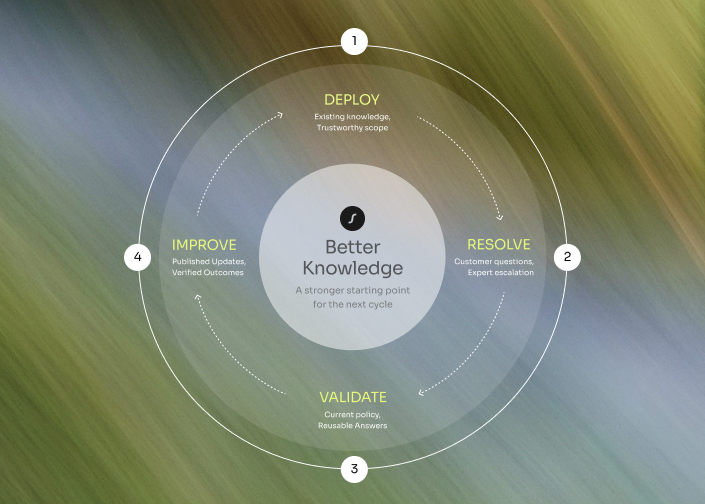
Many enterprises regard knowledge cleanup as a prerequisite for deploying AI in customer service. Their help centers are incomplete, policies are scattered across documents, and key information that should be written down and preserved lies only with individual agents. Waiting on a comprehensive knowledge project can seem like the responsible move. Except the business never stops changing. Crescendo’s position is that a safe AI deployment, supported by a tight continuous-improvement loop, can be the fastest path to higher-quality knowledge. The initial requirement is a trustworthy foundation for a deliberate service scope, together with a dependable operational response when the available knowledge is insufficient.
Comprehensive coverage can develop through the same process that resolves real customer problems.That foundation can begin with existing FAQs, help centers, policy documents, and other materials in the formats customers already use. Recent CX transcripts provide another source of candidate knowledge: the questions customers are asking now and the answers experienced agents use to resolve them. Those answers require validation before they become reusable guidance. A transcript only records what happened — it doesn’t fact check.
A central research hypothesis is that roughly 30 days of recent transcripts, combined with authoritative documents and an effective escalation process, may provide sufficient initial coverage for many CX deployments. Yes, longer histories may add a few additional answers, and they will also introduce obsolete products and policies. The threshold remains to be established by customer context, conversation volume, and measured performance.The operating loop determines what happens next. Crescendo’s Concierge Agent hands off unsupported situations. Tier 1 agents escalate to specialists when necessary. Validated resolutions become published knowledge, and subsequent conversations establish whether the changes work. Approval delays weaken this loop both by prolonging known gaps and by discouraging small corrections. Quality depends on the accuracy, currency, and usefulness of the overall system, as well as the care applied to individual articles.
The objective: trustworthy knowledge that improves quickly enough to keep pace with the business.
Knowledge readiness is an operating decision
A knowledge project can have a completion date. The responsibility for maintaining knowledge, however, cannot. New products, exceptions, and policy decisions keep rolling in long after the project team has wrapped. A successful cleanup creates a better starting point; its value then depends on how the operation responds to change.This distinction changes the deployment decision. An enterprise does not need to document every conceivable customer situation before delegating a defined set of work to AI. It does need evidence that Concierge can handle that work appropriately and that the surrounding operation can take responsibility for everything outside its scope.
The fact that human agents already serve customers using imperfect materials is useful context, but it does not by itself establish AI readiness. Experienced people often recognize exceptions or compensate for gaps using judgment and informal escalation paths. Those capabilities must be represented deliberately in an AI-enabled operation. The deployment needs validated use cases, clear handoff conditions, available experts, and evaluation of both answers and transfers.
Coverage should therefore be interpreted alongside quality and consequence. A system that answers common questions correctly and escalates unsupported cases may offer a stronger starting point than a larger library containing plausible but outdated instructions. Rare, consequential situations still require explicit treatment, even when they contribute little to overall conversation volume.
The deployment question becomes practical:
- Which work is supported by current, authoritative knowledge?
- How will the remaining work be resolved?
- How quickly can the operation incorporate what it learns?
This makes preparation bounded and improvement continuous.
Bootstrap off preexisting knowledge
Most organizations already possess far more usable knowledge than their formal help center suggests. FAQs capture repeated questions. Policy documents establish business intent. Troubleshooting notes contain hard-won operational experience. Presentations, PDFs, web pages, and internal documents hint at aspects of the service that have never been consolidated.
The Crescendo Knowledge Agent approach begins with that material. Content can arrive in the formats the customer already has; standardizing the source format should not become another prerequisite project. The task is to turn available information into a coherent foundation that can support customer service.
That work includes identifying authoritative sources, consolidating duplicate guidance, resolving contradictions, and retaining the context that determines when an answer applies. A rule may depend on product version, region, purchase date, or customer status. Removing that context in pursuit of a cleaner article can make the answer less reliable.Where documents disagree, the business must establish the correct policy. The Crescendo Knowledge Agent can surface a conflict and help prepare a revision, but it should not silently decide which policy the enterprise intends to honor. The resulting knowledge needs an accountable owner and a way to trace important guidance to its source.
Bootstrapping is a focused quality exercise. Start with the information needed for the agreed service scope, validate the common paths, and make the remaining gaps visible. The objective: a usable foundation that the operation can maintain, with the highest-impact uncertainties resolved first.
Recent conversations reveal what customers need now
Conversation transcripts provide a different view of knowledge from a document library. They show how customers phrase their needs, which details change the answer, and where agents repeatedly seek help. They can also expose knowledge that is effective in practice but absent from formal documentation.
Generating knowledge from those conversations involves more than summarizing them. Related questions need to be grouped, candidate answers compared, and conditions or exceptions retained. A resolution should be checked against current policy and, where necessary, reviewed by an expert. Customer-specific information and one-time concessions should not become general instructions.Recent history has a particular advantage: It reflects the business customers are encountering today. Older conversations may describe retired products, previous policies, or workarounds that an integration has since made unnecessary. More history expands the available evidence, but it also increases the work required to establish which evidence still applies.
Crescendo has run transcript-ingestion experiments using histories ranging from one month to three years. We found a substantial drop-off in the usefulness of additional history: Larger archives introduced more noise and slowed the path to high-quality CX knowledge.1 This supports testing whether roughly 30 days of recent transcripts, combined with authoritative content and a functioning escalation path, can provide sufficient initial coverage. The right starting window depends on the business and must be evaluated in service.
The proposed threshold concerns a starting point. A month may underrepresent seasonal demand, a low-volume product, or an infrequent but important issue. Such cases may require selected older conversations, specialist documentation, or scenario testing. The useful comparison is the additional current, correct coverage gained from each source, relative to the review effort and obsolete guidance it introduces.
Incomplete and incorrect knowledge fails differently
A recognized knowledge gap produces an actionable signal. Concierge lacks a supported answer, the conversation moves to a person, and the organization can investigate what information was missing. When an expert establishes the answer, the operation has a candidate improvement with a clear origin.
An incorrect article can be harder to diagnose. Concierge may retrieve it, apply its instructions, and deliver a confident response. If the customer’s problem remains unresolved, several explanations remain possible: the guidance was wrong, the customer’s situation differed from the documented case, an underlying system failed, or the instructions were misunderstood.
Neither failure mode is harmless, and a system will not recognize every gap reliably. Handoff behavior must be evaluated, and apparently successful automated resolutions still require quality review. The distinction is that a clear absence of support can direct investigation more precisely than a credible answer whose defect is initially hidden.
This is one reason to resist treating historical volume as a proxy for knowledge quality. An exhaustive archive may import answers whose authority has expired. Removing that material later requires detecting its effects, tracing the cause, and determining what should replace it. A deliberate current foundation reduces that burden while preserving a process for learning the missing cases.
A meaningful coverage measure asks whether a request can be resolved using current, validated guidance. It should be reported alongside answer accuracy, freshness, repeat contact, and appropriate escalation. Counting topics or articles alone cannot establish whether the knowledge serves the customer.
Escalation turns expertise into reusable knowledge
A customer service operation already has a hierarchy of expertise. Tier 1 handles common situations. Specialists, Tier 2 or Tier 3 teams, and business owners resolve exceptions that require deeper knowledge or authority. A learning system connects that hierarchy to the knowledge base.
Consider an illustrative retailer where Concierge cannot explain the status of an order shipped in multiple packages. Concierge hands off with the customer’s context. If Tier 1 cannot establish the answer, a specialist determines how item-level shipment status should be interpreted and confirms the applicable guidance.
The customer’s resolution starts the improvement process. The reusable answer must be separated from details unique to the order, checked against authoritative information, and published for the relevant service scope. Later partial-shipment conversations then provide evidence of whether the update reduced avoidable transfers and improved resolution.
The diagnosis matters. If the required information is unavailable from the backend, writing another article will not solve the problem. If the business reserves a decision for an expert, that escalation should remain. Knowledge improvement addresses a documented information gap; it does not authorize policy changes or expand Concierge’s permissions.
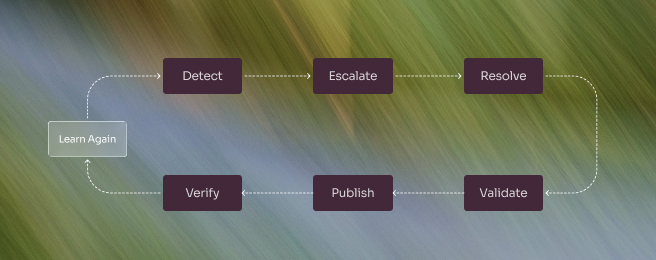
An accountable loop assigns responsibility at every transition. Who captures the gap? Who establishes the correct answer? Who can approve and publish it? Who checks the result? Without those connections, experts may resolve the same problem repeatedly while the shared knowledge remains unchanged.
Knowledge compounds when learning carries forward
An expert answer has immediate value to the customer receiving it. When that answer becomes validated, reusable knowledge, its value extends to later interactions. Other agents gain access to the resolution, and the AI can apply it within the scope for which it was approved.
The next interactions add evidence. They may show that the answer needs another condition, that the wording creates confusion, or that the underlying policy has changed. A maintained knowledge system uses that evidence to refine or retire the guidance. Improvement is recursive because the changed system produces the observations used to improve it again.
Compounding is an operating mechanism, not a promise of automatic exponential growth. Reusable resolutions can reduce repeated expert work. If the organization reinvests some of that capacity in resolving additional gaps, one improvement can help enable the next. Shared knowledge also reduces the risk that important answers depend on a single person being available.
A self-improving knowledge system still needs people to establish business intent, resolve consequential ambiguity, and govern changes. The system can help detect problems and prepare improvements while publication follows the organization’s decision rights. Learning here occurs through better operating knowledge and verified changes; it does not require the underlying model to retrain after every conversation.
The value of the initial deployment is broader than its launch-day coverage. It establishes if the organization can detect a missing answer, bring the right expertise, and carry the validated result into subsequent service. That capability remains useful as products, policies, and customer demand change.
Slow approval cycles can lower overall quality
In our customer work, we have encountered one- and two-week approval cycles for knowledge updates. We believe those delays can be a significant contributor to stale and incomplete knowledge. The observation needs measured customer evidence before it can support a claim about prevalence or relative impact across deployments.
The first cost is direct. A known gap remains in service while its correction waits. Customers continue to ask the affected question. Agents repeat workarounds, and experts spend time resolving cases that an approved update could help prevent. The delay is experienced through the conversations that occur during it.
The second cost is behavioral. A lengthy publication process makes small changes less attractive to submit. Clarifying a sentence, documenting an exception, or improving an unsuccessful search phrase can seem too minor to justify the effort. The organization loses improvements that never appear in an approval queue.
This helps explain an apparent paradox: carefully written, formally organized articles can coexist with a poor overall knowledge system. The individual documents may meet a demanding editorial standard while substantial areas of the business remain undocumented. Quality needs to be assessed across the service responsibility, including freshness and useful coverage.
Approval should reflect the consequences of the change. A clarification that preserves an approved policy may need a different review path from a change to customer eligibility or business authority. Defined owners, version history, appropriate tests, and a way to reverse an unsuccessful update support faster work without removing accountability.
The operating target is the shortest dependable path from a verified need to a verified live improvement. Speed earns its value when it delivers correct changes and makes their effects observable.
The mathematics of a shorter improvement loop
The simplest way to express the cost of delay is to count affected interactions. Suppose a known gap affects 20 conversations each day. Publishing a validated correction after one day rather than 14 avoids 13 additional days of exposure to that gap:

Those are conversations exposed to unresolved guidance, not necessarily incorrect answers or lost customers. Some may be handled successfully by people. The arithmetic illustrates how turnaround time affects repeated operational work without assuming a particular financial or customer outcome.
Repeated cycles provide a second illustration. Suppose an operation starts with 100 addressable knowledge gaps and each completed, verified cycle closes 10 percent of the gaps that remain. After n cycles, the remaining gaps are 100 × 0.9ⁿ. Over 28 days, the result depends on how many complete learning cycles the operation can perform:
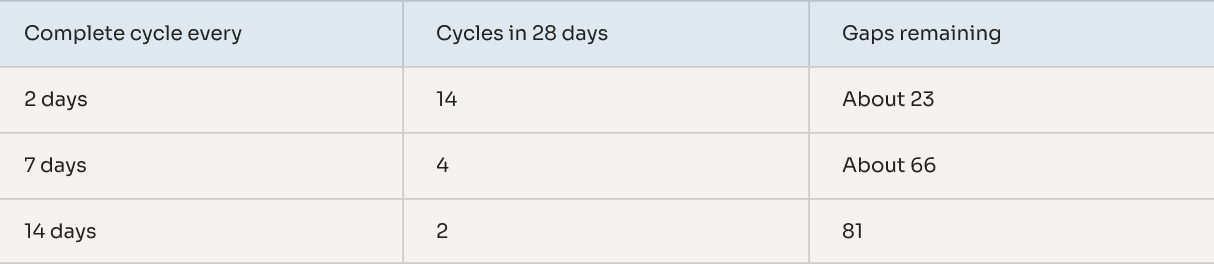
Illustrative model; these are not Crescendo customer results. The calculation assumes equal improvement per completed cycle, adequate expert and publishing capacity, no regressions, and no new gaps. Faster approvals alone do not establish those conditions. A slower cycle could also process a larger batch of changes.
The practical value of a short cycle is earlier exposure to the next round of feedback. A published change can be tested in service, corrected if necessary, and used to identify the next problem. In a changing business, the organization must also address new gaps as they arrive. The model motivates measuring the loop; it does not predict a deployment’s results.
Measure learning velocity alongside knowledge quality
A knowledge library can grow rapidly without becoming more useful. Bulk imports, duplicate articles, and formatting changes may increase activity while contributing little to service. Conversely, one correction to a frequently used policy can matter more than dozens of new low-use articles.
Crescendo customer research should therefore distinguish the amount of content changing from the value and speed of those changes. Creation, substantive revision, and retirement are different events. Counts of edits should be reported separately from counts of distinct articles. Monthly change rates need a defined active-article denominator and explicit treatment of migrations.3
The operational measure is elapsed time through the improvement process: detection, drafting, review, publication, and verification. Median turnaround describes the usual case; a slower-tail measure exposes changes that remain stuck. Save-to-publish time is useful where recorded, but it does not establish the full approval cycle or the time since the original knowledge gap was discovered.
Outcomes complete the picture. Did the affected question lead to fewer repeat contacts or avoidable escalations? Did answer quality improve? Did a published change introduce a new error? Evaluation should focus on the conversations that could be affected, while accounting for changes in demand, products, integrations, and Concierge’s behavior.
A credible study will state which customers and articles are represented, the exact observation period, and the limits of the available history. A current last-modified timestamp cannot reconstruct every prior change or distinguish publication from synchronization. Partial instrumentation should remain visible rather than being converted into a company-wide claim.
Build the system that makes knowledge better
The decision to deploy AI and the decision to improve knowledge can belong to the same operating plan. Existing materials provide a foundation. Recent conversations reveal current demand. Experts resolve the unsupported situations. Validated updates improve the conditions of the next interaction.
That approach creates a practical sequence: define the work, establish trustworthy knowledge for that scope, evaluate the answers and handoffs, and make improvement part of daily operations. Broader coverage follows where current evidence and expert judgment support it. Some boundaries will appropriately remain.
The enterprise should judge readiness by the dependability of that system, including the people who handle exceptions and the process that turns their resolutions into reusable knowledge. The ability to publish a correction promptly matters because customer questions continue while an article waits for approval.
Waiting for perfect knowledge can defer the very feedback that would make the knowledge better. A safe deployment with an accountable, rapid improvement loop gives the businessa way to learn from real service and carry that learning forward. The lasting advantage is knowledge that keeps pace with the operation it serves.
You don’t need perfect knowledge to deploy AI. Rather, you need trustworthy scope, dependable escalation, and a loop that turns experience into verified improvement.
Stop waiting for perfect knowledge
Perfect knowledge isn’t a prerequisite. It’s an outcome. Crescendo launches with a trustworthy scope, hands off everything outside it to your experts, and turns every resolution into validated knowledge that improves the next conversation. The result is a knowledge base that keeps pace with your business instead of falling behind it.
Set up a personalized conversation with us. We’ll show you how your existing help center, policies, and recent transcripts can become the foundation for a safe first deployment, with accountable improvement at every step.
