

AI That Shapes Customer Decisions: How Crescendo Influence Turns Every Conversation Into a Revenue Moment


For decades, customer support and commerce have been treated as separate systems: one designed to resolve issues, the other to drive revenue. But in reality, the highest-leverage moments in the customer journey rarely happen during product discovery or ad targeting. They happen in conversations – when customers ask questions, seek reassurance, compare options, or reconsider a decision already in motion.
A customer asking whether an order will arrive in time for a holiday.
A shopper unsure which version of a product actually fits their needs.
A subscriber quietly considering cancellation.
These are not just support moments. They are decision moments, and until now, no CX system has been built to influence them in real time.
That is the foundation of Crescendo Influence: an autonomous reasoning layer that turns context into timely guidance, helping brands grow revenue or reduce churn inside the natural flow of a conversation. No workflow, no script, and no separate sales journey. It combines personalization and memory with business context, so the same AI assistant can seamlessly deliver service and sales outcomes in a single interaction.
The industry buzz in 2026 has been all about agentic commerce. AI shopping agents that browse, compare, and buy on a customer's behalf. McKinsey projects the agentic commerce market could reach $3 to 5 trillion globally by 2030. Google, Microsoft and Shopify are actively developing brand agents, shopping copilots and zero-click checkout. That shift is real, and it matters. But most of the attention is still concentrated at the front of the journey: discovery, search, matching, and checkout acceleration.
What this perspective misses is where a disproportionate share of revenue is actually won or lost – the emotionally charged, high-intent moments after a customer is already engaged.
- A promo code fails at checkout.
- A gift shopper hesitates, unsure if the order will arrive in time.
- A loyal customer considers canceling, not out of dissatisfaction, but because their needs have changed.
- A returning customer is about to reorder an accessory that no longer fits the product they upgraded months ago.
These may appear to be service interactions. In reality, they are decision inflection points - moments where intent exists, but confidence does not.
This is the layer Crescendo Influence is designed to operate in.
The $79 conversation that became $267
Here is the clearest way to understand the shift.
A customer opens a chat on a premium outdoor family gear site to reorder a retractable canopy for her wagon. She knows what she wants. It should be a quick $79 purchase.
But Crescendo’s AI Assistant doesn’t just answer the request and move on. It recognizes that the customer upgraded from the Cruiser two-seater to the Cruiser XL last spring. The canopy she is about to buy will not fit her current wagon. Before checkout, the assistant catches the mismatch, explains the issue, and recommends the correct XL-compatible model.
That alone already saves the brand a return, a support contact, and a frustrated customer.
But the conversation does not stop there.
The assistant also sees that the weather cover she bought for her original wagon would not work with the XL either. It connects that product history to a more recent signal: the customer had previously mentioned an upcoming family camping trip. Now the AI has more than a cart. It has context. So it recommends the All-Terrain Weather Cover for the XL – a product she is likely to need within weeks, and one that works with the canopy she is already buying.
Then it notices something else: her youngest child just turned one. That makes a comfort seat a relevant accessory now, in a way it wasn't before. The assistant suggests it naturally, not as a generic “customers also bought” add-on, but as a timely, specific recommendation grounded in the customer’s world.
A $79 reorder becomes a $267 cart: the right canopy, the right weather cover, and a comfort seat that fits her current needs.
No coupon spam.
No pop-up barrage.
No hardcoded upsell script.
That is the crux of Crescendo Influence. It does not push products. It reduces friction, prevents mistakes, and creates value so effectively that revenue becomes a natural outcome.
A new AI architecture: Systems built on autonomy, not better recommendations
Traditional personalization in commerce is built on a familiar toolkit: collaborative filtering, static segments, promotions, urgency triggers and recommendation carousels. These approaches can work, but they share the same basic assumption that personalization is a targeting problem.
Find the right audience. Show the right offer. Optimize the click.
But the moments Crescendo Influence is designed for are not targeting moments. They are conversation moments.
The customer is already engaged. Often they already have intent. What they lack is certainty. Or confidence. Or context. They need help making the right decision at the right moment. That is a fundamentally different problem.
It requires a system that can understand multiple moving parts at once: purchase history, current intent, compatibility constraints, loyalty status, emotional state, business goals, channel context, and brand guardrails. It requires something closer to judgment than targeting.
And that is where legacy architectures break.
Workflow-based systems are brittle. They can route, classify, and trigger prewritten logic, but they do not truly reason. They do not adapt gracefully when a conversation spans multiple topics. They do not naturally recognize when solving a customer’s problem opens a window to create additional value. They do not build memory dynamically. And they do not improve simply because more context became available.
Crescendo’s architecture is different by design. The system is built on autonomy over orchestration. Rather than drawing fixed decision trees for every edge case, we give the AI clear goals, deep knowledge, policy context, and tool access, then let it reason about the best next step.
How Crescendo Influence works: The Influence Loop
The simplest way to describe Crescendo Influence is this: Every conversation becomes a memory. Every memory becomes context. Every piece of context can shape the next action.
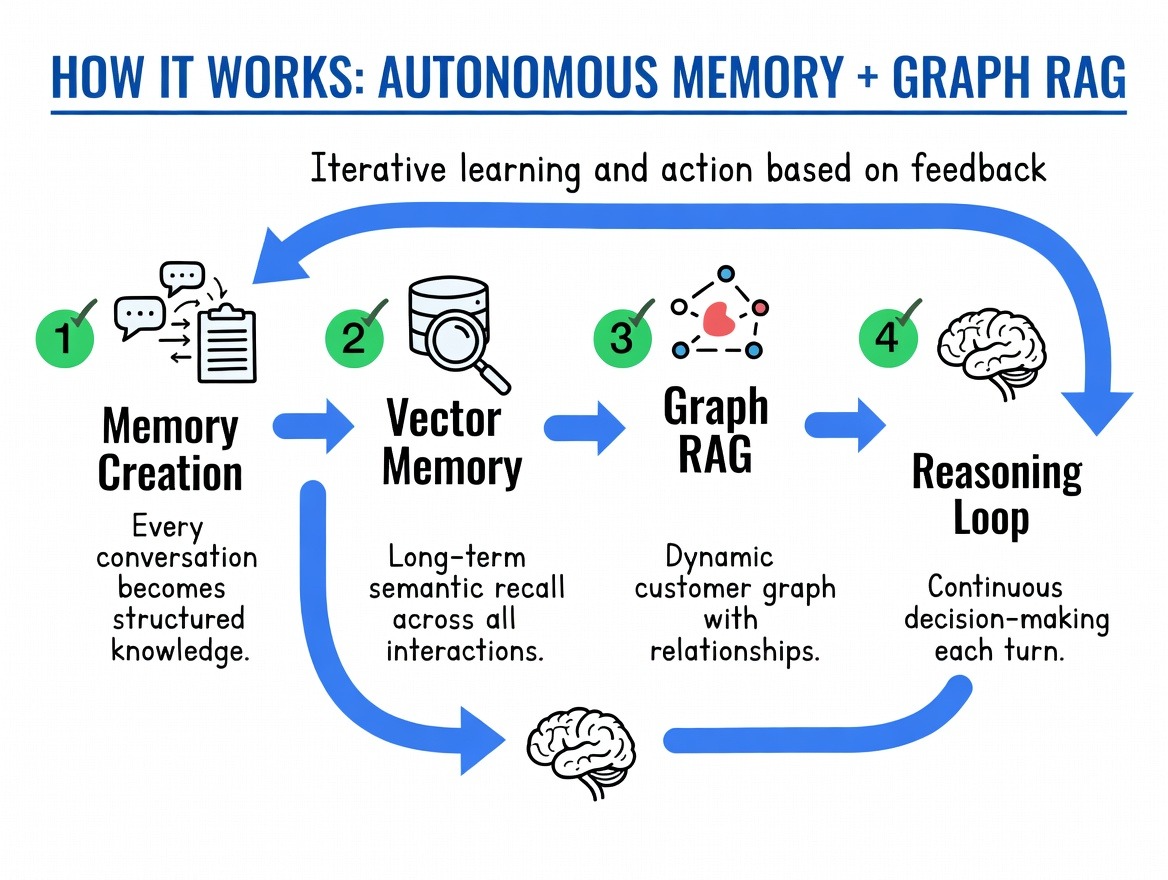
1. Autonomous memory creation
Most CX systems only know what they were explicitly told to store. Crescendo Influence is designed to learn as the conversation unfolds.
Each interaction can be transformed into structured memory: facts, preferences, intent signals, time-bound events, product constraints, subscription status, household context, loyalty markers, and more. Instead of forcing admins to predefine every possible field as a relational database, the system can infer what matters from unstructured conversation and tool outputs. A continuously evolving customer graph built from unstructured human conversations, with AI-generated nodes representing the customer’s world and relationship edges connecting them.
In practice, this is where autonomous memory begins. The assistant does not just read the conversation. It turns it into usable knowledge.
2. Vector memory as long-term semantic recall
Once that knowledge is extracted, it should not disappear when the session ends.
This is where vector memory matters. New interactions can automatically generate vector database entries that capture the semantic meaning of what was learned - not just exact phrases, but patterns, preferences, and relationships. That creates long-term memory across chat, voice, email, and messaging, so the AI can retrieve the right context later, even if the customer never repeats it word for word.
A camping trip mentioned weeks ago becomes relevant when the customer returns to buy stroller accessories. A gifting concern becomes relevant when shipping urgency arises. A cancellation request is interpreted differently when the AI knows the customer has a long purchase history but recent usage fatigue.
This is not memory as transcript storage. It is memory as retrieval-ready understanding.
This changes the role of the model’s context window entirely. The system no longer depends on fitting a customer’s full history into a single prompt. Instead, it continuously builds memory and retrieves only what matters for the decision at hand.
The challenge shifts from how much context can be processed to how precisely the right context can be selected.
And this directly impacts answer quality. The more effectively the assistant can recall the right context from the customer’s history, the less it has to guess, the fewer qualifying questions it asks, and the more accurate its recommendations become.
3. Dynamic customer graph and Graph RAG
Vector memory is powerful, but semantic recall alone is not enough. Commerce and service are full of relationships: this accessory fits that product, this subscription belongs to that household, this cancellation reason relates to that prior order, this approval depends on that stakeholder, this issue spans two topics at once.
That is where the graph comes in. Graph RAG makes that structure operational.
The AI can create and update nodes for products, people, preferences, accounts, orders, and inferred entities, then link them with meaningful relationships. A single customer message can also spawn multiple dynamic intents, each of which can trigger its own smart action.
Instead of retrieving only isolated chunks of text, the system can retrieve relationship-aware context: what this customer bought, how it connects to what they are asking now, what constraints exist, what tools are available, and what action is appropriate. The result is dynamic context rather than static retrieval.
That is what lets the AI reason like this:
- This canopy will not fit because the customer upgraded the base product last year.
- This support inquiry is actually a gifting decision in disguise.
- This subscriber should be offered a pause or swap, not a discount, because their issue is flexibility rather than dissatisfaction.
- This customer has two existing needs in the same message, so the system should handle them in parallel rather than forcing a single intent label.
That is the difference between an answer engine and a reasoning system.
4. A continuous reasoning loop
What feels like “autonomous thinking” to the end user is really a continuous reasoning loop grounded in memory, graph relationships, tool access, policies, and business goals.
With every message or action, the system updates those goals by weaving together conversational context, past purchases, CRM/ticketing data, browsing signals, product information, and business policies. Then it selects the next best Influence Action - a recommendation, a save-the-sale suggestion, a logistics assist, a churn-prevention move - timed to the customer’s actual moment.
This is why Crescendo Influence does not feel like a separate sales assistant layered on top of support. It is the same assistant, in the same conversation, using the same context to decide what should happen next.
From reasoning to action: Smart actions, human review, and attribution
Reasoning only matters if it can do something useful. Dynamic intents can trigger tool calls or API actions in parallel - checking order status, validating product fit, issuing a refund, recommending a substitute, updating a subscription, or escalating when necessary. And when a situation requires authorization, confidence is low, or the customer requires special handling, the system can create a human-in-the-loop review with the right context and recommended action.
That hybrid model matters because real CX is messy. Not every moment should be fully automated. The point is to let the AI do the reasoning, retrieval, and orchestration fast enough that humans step in only where they add the most value.
Then comes the piece most systems miss: attribution.
Crescendo Influence is not just making recommendations. It can tag influence actions, connect them to downstream purchases or retained subscriptions, and measure whether the intervention actually changed the outcome. That creates the instrumentation needed to improve the AI’s judgment over time. This is zero-touch attribution, not vanity reporting.
What this looks like in production for our customers
The pattern shows up across very different brands.
At Lovepop, order-arrival questions during the Valentine’s rush were not just support tickets, they were active gifting decisions. Crescendo’s AI assistant could answer shipping questions, recognize gifting context, and guide customers to the right card or bouquet, influencing product selection in 30% of these conversations in early deployments.
At TOMS, sizing and fit conversations became conversion moments. Instead of answering a question and letting uncertainty linger, the AI assistant could resolve the concern, restore confidence, and naturally build toward a fuller cart.
At Sweet Bee Organics, the static quiz gave way to a live wellness concierge. The AI assistant could ask follow-up questions, account for a customer’s existing routine, recommend the next best product, and even turn cancellation conversations into retention opportunities through pause or swap options. Guided discovery conversations accounted for up to 19% of chats.
Different brands. Different verticals. Same architecture.
The AI is not following a rigid playbook. It is reasoning inside the moment.
Why this architecture compounds
The most important thing about this system is not just that it works now. It is that it improves in a compounding way.
- Each new conversation creates more memory.
- Each new integration adds more usable context.
- Each model improvement strengthens the system’s reasoning.
- Each attributed outcome sharpens its judgment about when and how to intervene.
That is why this architecture matters more than any individual feature. It improves with every conversation, every integration, and every attributed outcome.
When the agent gains access to a new tool or source of context, it does not simply use it mechanically. It becomes a more capable service and sales persona without requiring someone to rebuild workflows from scratch.
That is the advantage of building on autonomy, memory, and reasoning rather than static orchestration.
What this means for commerce leaders
The next generation of winning brands will not be the ones with the noisiest recommendation engine or the most futuristic shopping demo. They will be the ones that recognize a simpler truth:
The highest-leverage moments in the customer journey occur when the customer already has intent and is seeking help.
Every support interaction is a potential revenue surface.
Every checkout friction point is a conversion opportunity.
Every cancellation request is a retention moment.
The question is whether your AI is intelligent enough to recognize those moments, and trustworthy enough to act on them in a way that feels helpful rather than manipulative.
That distinction matters.
- A generic pop-up that says “don’t forget socks” is not intelligence, it is noise.
- An assistant that notices the order is a gift, sees that shipping timing is tight, recommends the right product, and offers the right fulfillment option is service.
- An assistant that catches an incompatibility before checkout is service.
- An assistant that understands a loyal subscriber needs flexibility, not a hard sell, is service.
That is the kind of influence that builds loyalty rather than erodes it.
Crescendo Influence is built for that second category, not as a conversion layer bolted onto support, but as a unified intelligence that treats every customer interaction as an opportunity to create value – and measures whether it actually did.
The era of separating service from sales, of treating support as a cost center, and of building CX around brittle workflows is ending.
What replaces it is something more adaptive and more human: An AI that remembers, reasons, and acts with context.
And in doing so, it turns every conversation into a revenue moment.
To learn more about Crescendo’s AI Assistants, visit https://www.crescendo.ai/product/omnichannel-ai
Run Your Entire CX Operation on One AI-Native Platform

Keep Reading
