

Customer Sentiment Analysis: Actionable Guide for Businesses | 2026


What is Customer Sentiment Analysis?
Definition: Customer Sentiment Analysis is the process businesses use to understand how customers feel about their products, services, or brand. It leverages technology, most commonly artificial intelligence (AI) and natural language processing (NLP), to analyze customer data such as support conversations, online reviews, social media posts, survey responses, and emails.
Based on this analysis, customer feedback is typically classified as positive, negative, or neutral, helping companies identify satisfaction levels, pain points, and overall brand perception.
In short, sentiment analysis is like a digital "mood detector" for customer opinions, helping businesses make smarter decisions.
How Customer Sentiment Analysis Works
1. Data Collection
The system collects customer feedback from everyday touchpoints like emails, live chat conversations, call transcripts, surveys, online reviews, and social media comments.
2. NLP & AI Understanding
Using Natural Language Processing (NLP) and AI, the system reads the text the way a human would, understanding context, intent, and emotion rather than just keywords.
Example: It understands that “I’ve been waiting forever” signals frustration, even if the word “angry” is never used.
3. Sentiment Classification
Each piece of feedback is classified as positive, negative, or neutral. More advanced systems also detect emotions like frustration, satisfaction, urgency, or excitement.
Example:
- “Amazing support, solved my issue in minutes” → Positive
- “This is the third time I’ve contacted support” → Negative (frustration)
- “Just checking my order status” → Neutral
4. Aspect-Based Sentiment Analysis
Instead of labeling the entire message as good or bad, the system breaks feedback down by specific aspects such as product features, pricing, delivery, or support quality.
Example:
- “The app design is great, but customer support is awfully slow”
→ Positive sentiment for product design
→ Negative sentiment for customer support
5. Quantifiable Insights for Action
Finally, all this subjective feedback is converted into clear metrics and reports that teams can act on, like sentiment trends, top complaint categories, or CSAT-style scores.
Example: A CX leader can see that delivery-related frustration increased by 18% last month, even though overall reviews still look positive, allowing them to fix issues before they escalate.
7 Customer Sentiment Analysis Tools with AI
Here are seven popular AI tools for customer sentiment analysis. It’s important to note that there is no single “all-in-one” solution on this list. Each tool analyzes sentiment from specific types of customer data or channels, such as social media, surveys, reviews, or support conversations.
To get a true 360-degree view of customer sentiment, businesses typically need to combine two or three of these tools, depending on where their customer interactions happen.
1. Crescendo AI
Speciality: Crescendo.ai analyzes customer support conversations across chat, email, phone, and SMS, calculates a sentiment score for each interaction, explains why that score was given, and recommands teams how to improve future customer experiences.
How it works
Crescendo.ai is an AI customer support platform that provides end-to-end customer sentiment analysis across real support conversations, not just surveys or social mentions.
The platform analyzes interactions from live chat, email, phone calls, and SMS using advanced AI and NLP to understand customer emotions, intent, and outcomes.
Customer Support Sentiment Analysis:
- Detects emotions such as frustration, satisfaction, confusion, or urgency
- Assigns a sentiment score to every conversation
- Clearly explains why a conversation received that score
- Recommends actionable improvements for agents, workflows, or knowledge bases
Automated CSAT Scoring:
- Automatically calculates CSAT for 100% of conversations from sentiment analysis
- Eliminates reliance on low-response customer surveys
- Uses signals like tone, resolution speed, escalation behavior, and keywords
CX & Leadership Insights:
- View sentiment and CSAT agent-wise, category-wise, and time-wise
- Identify what’s working, what’s not, and where agent coaching is needed
- Get insights without manually reviewing transcripts or recordings
This makes Crescendo.ai especially useful for teams looking to operationalize sentiment analysis directly inside customer support, rather than treating it as a standalone analytics layer.
Here are some screenshots showing how Crescendo.ai's VoC tool has calculated the sentimental analysis of customer support tickets.
Example 1:
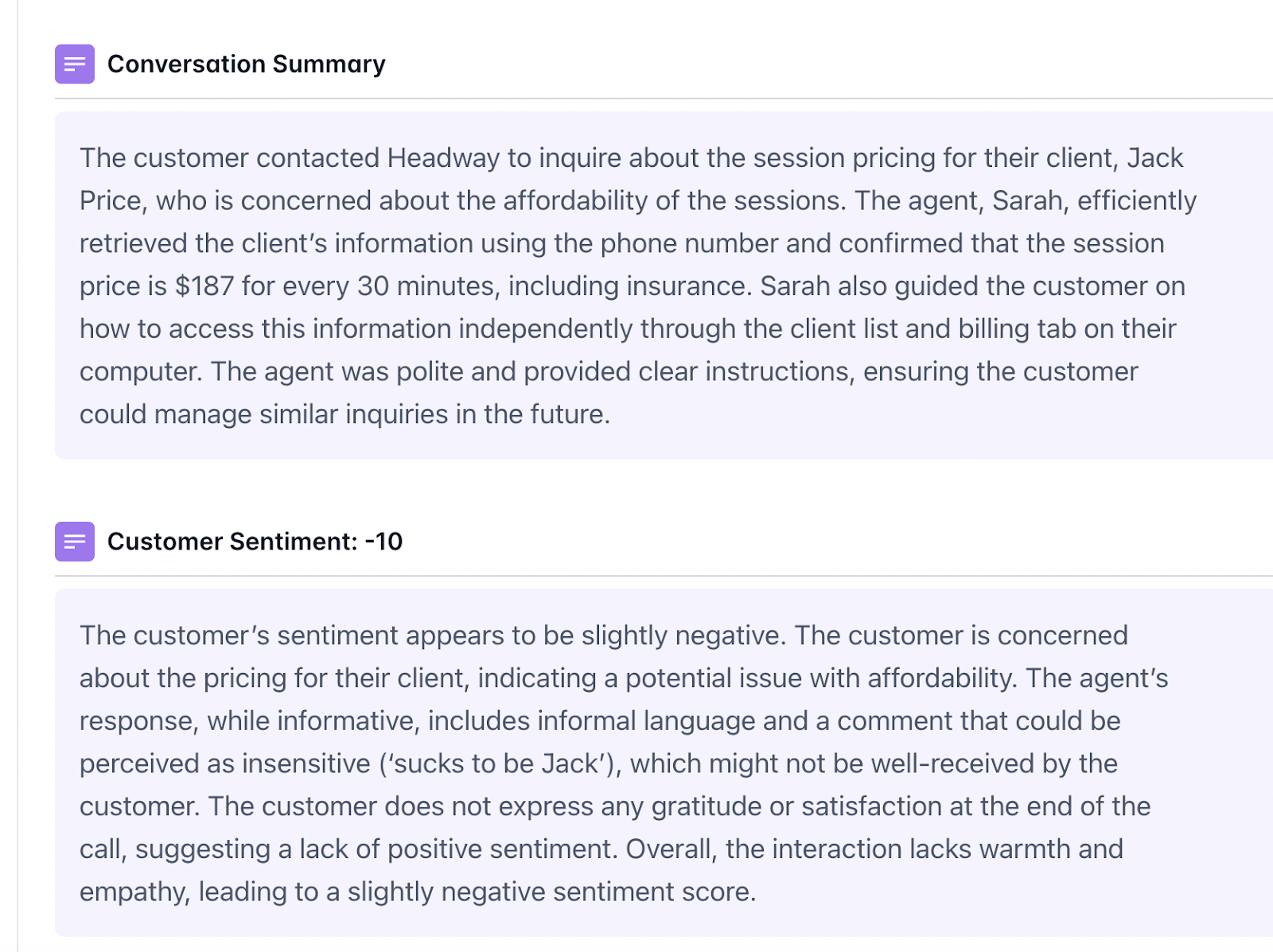
Example 2:

Example 3:
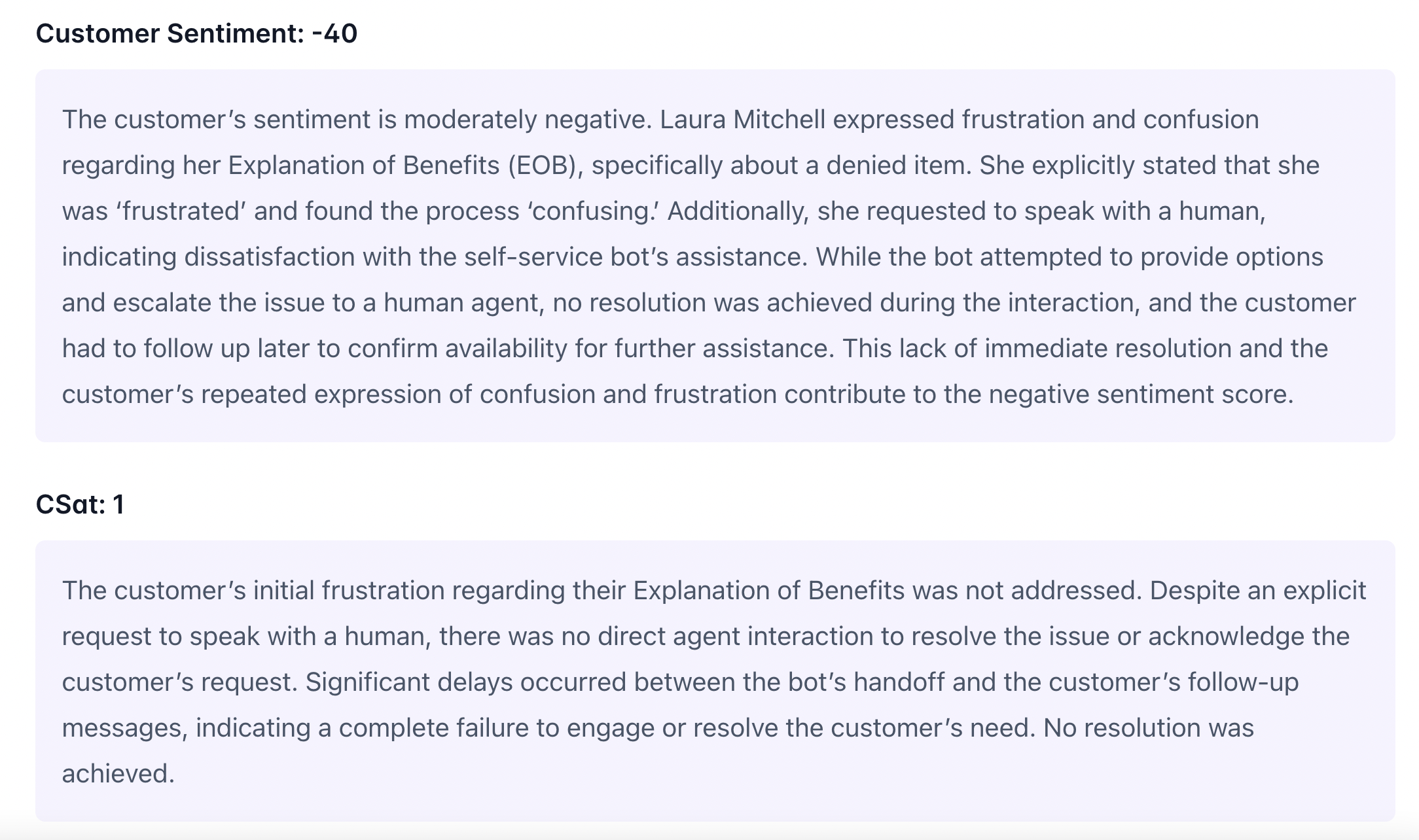

2. Meltwater
Meltwater offers a comprehensive customer sentiment analysis service that enables businesses to understand public perception by analyzing vast amounts of online content.
This analysis is applied to a wide range of sources, including social media platforms, news articles, blogs, and forums. The platform supports sentiment analysis in 218 languages and dialects, allowing businesses to monitor global conversations and understand sentiment across diverse markets.
Multilingual Social Analysis: Meltwater's social listening tools provide real-time monitoring of brand mentions and associated sentiments. Users can set up automated alerts to notify them of sudden changes in sentiment, enabling swift responses to emerging issues or crises.
Visual Sentiment Analysis: Beyond text, Meltwater offers visual enrichments that analyze non-textual content, such as images. This includes recognizing logos, celebrities, emotions, and scenes within images, providing a more holistic view of brand perception.
3. SentiSum
SentiSum is a dedicated AI-powered sentiment analysis platform designed specifically for analyzing customer support and feedback data at scale. It helps businesses understand why customers are happy or frustrated by automatically categorizing large volumes of unstructured feedback.
The platform analyzes data from sources such as customer support tickets, live chat transcripts, emails, app reviews, and CSAT/NPS comments. By using advanced natural language processing (NLP), SentiSum surfaces sentiment trends and root causes behind customer issues, without manual tagging.
Customer Support Sentiment Analysis: SentiSum specializes in understanding sentiment within customer service conversations. It automatically groups feedback into themes like product issues, bugs, billing problems, or feature requests, while identifying whether customers feel frustrated, satisfied, or confused.
Operational Insights & Trend Detection: Beyond simple positive or negative labels, SentiSum highlights recurring pain points and emerging issues over time. This allows support, product, and CX teams to prioritize fixes, improve knowledge bases, and reduce ticket volume based on real customer sentiment.
4. Qualaroo
Qualaroo is a customer sentiment analysis platform focused on capturing in-the-moment user sentiment through targeted surveys and questionnaires. It helps businesses understand how users feel while interacting with websites, apps, or digital products.
The platform primarily collects qualitative feedback through on-site surveys, in-app prompts, and email surveys. AI-powered text analysis then interprets responses to determine customer sentiment and underlying intent.
Survey-Based Sentiment Analysis: Qualaroo analyzes open-ended survey responses to classify sentiment as positive, negative, or neutral.
Example: A response like “The pricing page is confusing” is automatically tagged as negative sentiment related to pricing clarity.
Contextual Customer Insights: Because surveys are triggered based on user behavior (such as exit intent, page visits, or feature usage), Qualaroo ties sentiment directly to user actions. This helps product, marketing, and UX teams understand why users drop off, convert, or struggle at specific touchpoints.
5. Brand24
Brand24 is a social media monitoring tool that employs advanced artificial intelligence (AI) and machine learning techniques to conduct sentiment analysis, helping businesses understand public perception of their brand, products, or services.
Data Collection: Brand24 continuously monitors various online platforms, including social media sites, blogs, forums, news outlets, and more, to gather mentions of specified keywords related to a brand or topic.
AI-Powered Sentiment Analysis: Utilizing state-of-the-art deep learning and pretrained language models (PLM), Brand24's algorithm analyzes the collected text to determine the sentiment expressed. This involves assessing the emotional tone of the content to classify it as positive, negative, or neutral.
User Interaction and Manual Adjustments: While the AI strives for high accuracy, users can manually adjust the sentiment classification of specific mentions if discrepancies are found, ensuring the data reflects true public perception.
.webp)
In the above screenshot, Brand24's AI tool has analyzed the number of positive and negative comments on a social media site.
6. Zonka Feedback
Zonka Feedback is a customer experience and sentiment analysis platform that helps businesses capture, analyze, and act on feedback in real time.
It collects feedback across multiple touchpoints, surveys (CSAT, NPS, CES), website and in-app widgets, email/SMS, QR codes, kiosks, and CRM or helpdesk integrations. Its AI-powered NLP automatically detects sentiment, categorizes themes, and surfaces emerging trends from open-text responses, no manual effort required. Zonka Feedback turns raw customer feedback into decisions that drive measurable CX improvements.
Sentiment & Text Analysis: Identifies positive, negative, and neutral sentiment at scale. This helps businesses uncover root causes behind customer dissatisfaction, identify promoters and detractors, and gain a deeper understanding of customer emotions at scale.
Closed-Loop Feedback:Closed-Loop Feedback & Real-Time Alerts: Beyond analysis, Zonka Feedback enables action through real-time alerts, automated workflows, and ticket creation. Businesses can immediately follow up with unhappy customers, assign issues to teams, and track resolution progress.
Trend Dashboards: Custom reports and performance dashboards help teams monitor sentiment over time and measure CX initiative impact
7. IBM Watson
IBM Watson employs advanced natural language processing (NLP) and machine learning techniques to perform customer sentiment analysis through its Watson Natural Language Understanding (NLU) service. Here's how it works.
Data Collection: Watson NLU processes unstructured text data from various sources, such as customer reviews, social media posts, emails, and more. Users input this text into the Watson NLU service for analysis.
Sentiment Analysis: The service analyzes the overall sentiment of the text, determining whether it is positive, negative, or neutral. This helps businesses understand the general tone of customer feedback or public opinion.
Emotion Detection: Beyond basic sentiment, Watson NLU can detect specific emotions such as joy, anger, disgust, sadness, and fear. This provides a deeper understanding of the emotional nuances in the text.
Targeted Sentiment Analysis: Watson NLU offers targeted sentiment analysis, which assesses sentiment toward specific entities or aspects within the text. For example, in the sentence "I love the camera on this phone, but the battery life is disappointing," the service can identify positive sentiment toward the camera and negative sentiment toward the battery life.
Benefits of Customer Sentiment Analysis
Using sentiment analysis can improve customer interactions while influencing product improvements, marketing strategies, and risk management efforts.
1. Better Customer Service
Sentiment analysis helps streamline and improve customer service. In fact, 83% of U.S. consumers say good customer service is critical for brand loyalty [4].
For example,
- James Villas used SentiSum to prioritize urgent cases, reducing resolution times by 51% [1].
- Glammmup saw their Customer Satisfaction Score (CSAT) rise from 68 to 82 within a year by leveraging sentiment analysis [1].
- Lakrids by Bülow identified an increase in packaging complaints through sentiment analysis, updated their packaging, and reduced complaints by 26% by 2021 [1].
"Through using Sentisum we've significantly reduced the time it takes to unearth customer insights. We now understand these at a much more granular level, which allows us to quickly put actions in place to drive improvements." - Joe Quinlivan, Head of Customer Care @ Gousto [1]
2. Product Development Insights
Sentiment analysis also plays a role in refining products. One electronics brand reviewed feedback on its wireless earbuds, uncovering common complaints about fit and battery life. After making improvements, their product ratings jumped from 3.8 to 4.6 [3].
The financial upside of addressing customer feedback is clear:
3. Marketing and Sales Impact
Sentiment analysis can enhance marketing and sales efforts.
- The Atlanta Hawks used Sprout Social to refine their social media approach, leading to a 127.1% increase in video views and a 170.1% growth in their audience within three months [4].
- Expedia Canada reworked a violin-themed TV ad after identifying viewer irritation through sentiment analysis. The revised, humor-driven campaign was a success [5].
- Webconnex discovered that customers were feeling reluctant to make a purchase in the absence of 24/7 multilingual support. After addressing this challenge by partnering with Crescendo, an agentic-AI customer support solution, they achieved over 12,000 additional ticket sales year-over-year.
4. Risk Management
Tracking sentiment can also help identify risks and protect brand reputation. Brands use customer sentiment analysis for risk management by continuously monitoring customer conversations, reviews, and feedback to detect early signs of dissatisfaction, frustration, or trust issues before they escalate into bigger problems. Sudden spikes in negative sentiment around areas like billing, product failures, security, or support delays can signal operational, reputational, or compliance risks. By spotting these patterns early, companies can intervene proactively, fix issues, retrain agents, adjust messaging, or escalate cases, reducing the risk of churn, public backlash, regulatory complaints, or brand damage.
Ethics and Guidelines
As AI grows more powerful, ethical considerations take center stage. Here are some critical areas to focus on:
One example of ethical AI in action comes from Private AI. While analyzing Starbucks customer reviews, they developed a system to redact employee names while preserving location data. This approach ensured privacy without compromising the accuracy of their insights.
To responsibly harness AI, organizations should:
- Use strong data encryption methods
- Regularly test for and address bias in AI models
- Maintain transparency in decision-making processes
- Train staff on ethical AI practices
- Establish clear governance and accountability frameworks
The future of sentiment analysis depends on balancing progress with ethical responsibility, ensuring that as these tools grow more sophisticated, they remain fair and protect user privacy.
Summary
Understanding customer sentiment is crucial to keeping up with rising customer expectations. For example, 73% of customers want businesses to acknowledge their specific needs [15], and 82% expect responses in under 10 minutes [17]. Clearly, addressing customer emotions is critical.
The business benefits of sentiment analysis are clear:
Customer sentiment analysis is basically your customers telling you the truth, whether you ask for it or not. When you listen closely, patterns emerge, risks surface early, and opportunities stop hiding in plain sight. In a world where customers expect brands to get it instantly, sentiment analysis isn’t a “nice-to-have” anymore, it’s how smart teams stay ahead, fix issues faster, and turn everyday conversations into better experiences (and fewer angry emails).
"Sentiment analysis is an integral part of delivering an exceptional AI customer experience. It helps you understand the nuances of emotion that drive satisfaction, loyalty and advocacy." – Sprout Social [15]
Run Your Entire CX Operation on One AI-Native Platform

Keep Reading
