

7 Best Omnichannel Customer Service Software + Tools | 2026


By 2026, omnichannel customer service isn’t a “nice-to-have” anymore, it’s the default expectation. Customers don’t think in channels. They just want help, instantly, without repeating themselves, and without feeling ignored or misunderstood. Let's explore what is omnichannel customer support, how it has evolved in 2026 and what are the best omnichannel customer service software and tools available in the market for enterprises.
What is omnichannel customer support?
omnichannel customer support means helping customers across multiple channels i.e. chat, voice, email, SMS, social, and more, while keeping everything connected. No lost context. No starting over. One continuous conversation, no matter through which support channel customer has reached out.
Think of it as a hub where all customer messages and support tickets from different platforms come together. Instead of handling separate conversations on social media, chat, email, and phone calls, support agents see everything in a single dashboard.
For example:
- A customer starts a chat on a company’s website.
- Later, they send a follow-up email.
- If they call support, the agent can see all past messages, so the customer doesn’t have to repeat their issue.
Managing customer interactions across multiple platforms can be complex. That's why, a powerful omnichannel customer support software like Crescendo.ai is necessary to simplify this process and unify communications from chat, email, social media, and voice into one seamless system.
3 Major Revolutions in Omnichannel Customer Support in 2026
Omnichannel customer support isn’t new but in 2026, it looks very different from what most teams are used to today due to the rapid advancements in AI.
Here are the three biggest evolutions shaping omnichannel customer support in 2026.
1. Multimodal AI (Chat + Voice in One Interface)
In 2026, multimodal AI is the latest version of omnichannel AI. It allows chat and voice to live inside the same interface.
A customer can start typing, switch to voice or audio mid-conversation, send an audio note, or upload images, files, and documents, without losing context. The conversation flows naturally, just like talking to a real person. No transfers. No channel switching. No friction.
Watch the video below to see multimodal AI in action. The customer starts with live chat, switches to voice to explain a complex issue, and then shares screenshots, all within the same chat window.
2. Omnichannel Sentiment Analysis (Always On)
By 2026, sentiment analysis runs quietly in the background across every channel i.e. chat, voice, email, and SMS.
If a customer sounds frustrated on a call, confused in chat, or angry in email, the system detects it instantly. When that call is transferred to human agents or customer reaches out again, on any channel, the AI or human agent is already alerted:
- The issue isn’t resolved
- The customer is frustrated
- The response tone matters
This ensures agents don’t just know what to say, but how to say it, leading to faster resolutions and better customer experiences.
3. Unified Omnichannel Analytics (One Customer, One Story)
In 2026, omnichannel analytics are fully unified. Every interaction, chat, call, email, SMS, lives under a single customer profile. No scattered tools. No siloed reports.
Support teams get a complete, real-time view of:
- Issue history and resolution paths
- CSAT and sentiment trends over time
- Repeated pain points across channels
- Where conversations stall or escalate
More importantly, modern omnichannel platforms like Crescendo.ai don’t just show data, they turn it into action. Teams get clear recommendations on what to automate, where customers are getting frustrated, which responses improve CSAT, and what needs fixing upstream.
In 2026, omnichannel support isn’t just connected, it’s intelligent, empathetic, and insight-driven.
7 Best Omnichannel Customer Service Tools for Businesses
Here’s our curated list of the most revolutionary omnichannel customer service platforms for enterprises in 2026.
1. Crescendo.ai
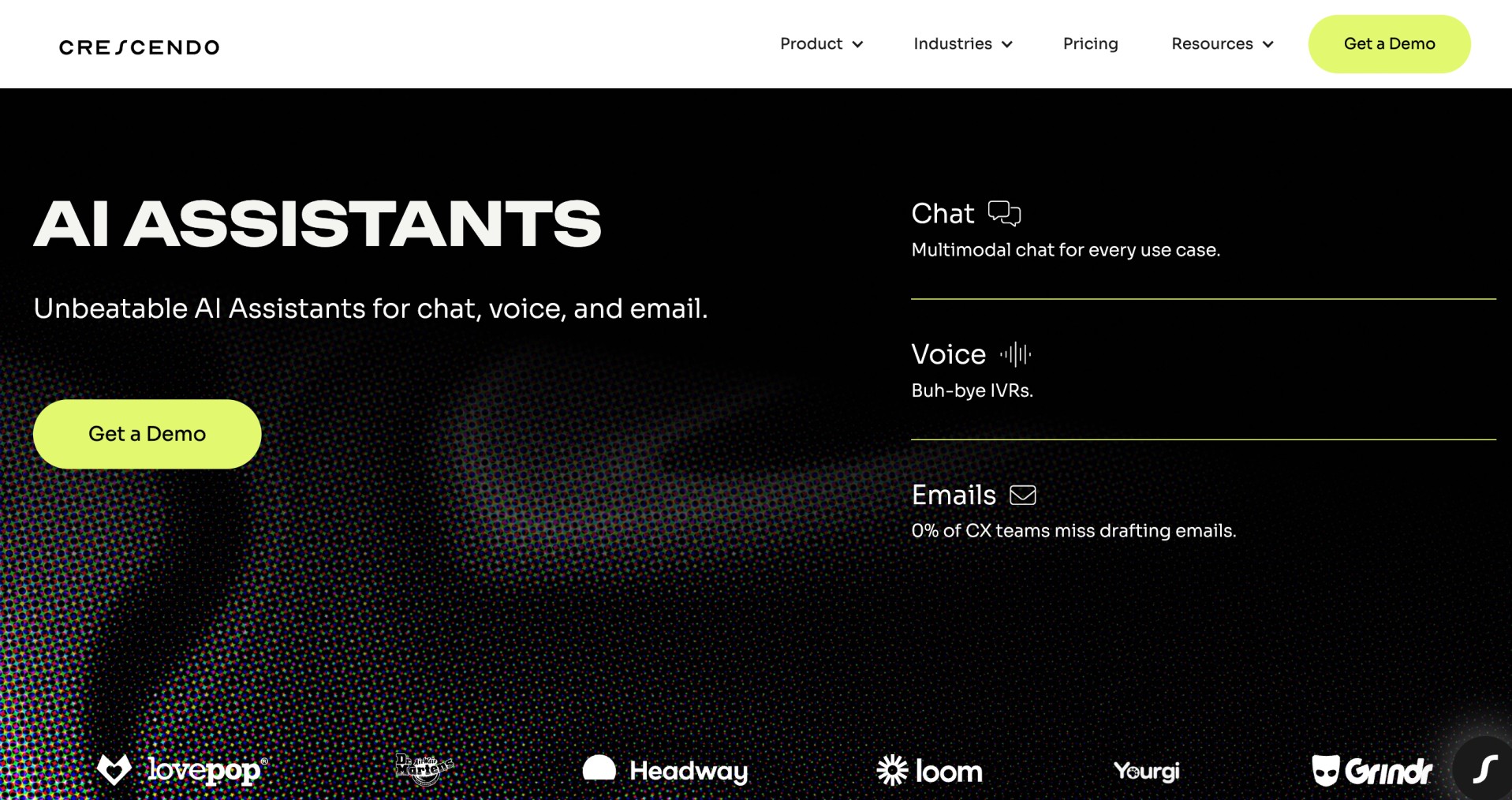
Crescendo.ai is one of the most revolutionary omnichannel customer service platforms for enterprises in 2026. It goes far beyond traditional omnichannel tools by combining advanced multimodal AI, unified sentiment intelligence, and deep omnichannel analytics, all delivered as a fully managed solution.
Key Features
1. True Omnichannel, Multilingual Support: Crescendo.ai delivers 24/7 omnichannel customer support across chat, email, SMS, and voice, fully connected under one system. It supports 50+ languages with native-like fluency, making it ideal for global enterprise teams serving customers across regions and time zones.
2. Multimodal AI (Chat + Voice in the Same Interface): Crescendo.ai is one of the few platforms that supports voice and audio messages inside the same chat interface. Customers can start typing, switch to voice to explain a complex issue, send audio notes, and share images, screenshots, or documents, without changing channels or sending follow-up emails.
The AI agents can read files, understand visuals, process audio, and make decisions just like a skilled human support representative, keeping conversations fast, natural, and frictionless.
3. Unified Sentiment Analysis Across All Channels: In 2026, sentiment matters as much as speed and Crescendo.ai tracks it everywhere. Sentiment analysis runs continuously across chat, voice, email, and SMS.
If a customer is frustrated due to unresolved back-and-forth emails and later reaches out on live chat, the system instantly alerts the AI or human agent about the unresolved issue and customer’s emotional state and the urgency and tone required.
This ensures responses are not just correct, but empathetic and context-aware, leading to higher CSAT and fewer escalations.
4. Omnichannel Analytics with Actionable Insights: All customer interactions across every channel are stored under a single customer profile. Support teams get a unified view of the entire customer journey, issues, CSAT for each interactions and more under the same umbrella.
5. Fully Managed Omnichannel Deployment & Maintenance: Unlike DIY platforms that require heavy involvement from engineering, CX leaders, and support teams, Crescendo.ai handles everything under one roof. Their engineers and CX experts manage deployment, integrations, knowledge-base setup, continuous optimization, and ongoing maintenance, tailored to your business needs.
In 2026, Crescendo.ai isn’t just an omnichannel tool; it’s a fully managed, intelligent customer support engine built for enterprise scale.
Pricing
Starts from $1.25 per resolution plus a fixed monthly fees for deployment, integrations, white-labeling and ongoing maintenance services.
2. Dixa
Dixa is a conversational omnichannel customer service software that replaces traditional ticketing with continuous, context-rich conversations. It unifies phone, email, chat, WhatsApp, and Facebook Messenger into a single agent interface, so customers never have to repeat themselves, regardless of which channel they started on. While Dixa handles omnichannel well at the channel-routing level, it lacks the deeper AI resolution capabilities and fully managed deployment that more advanced platforms offer.
Key Features:
- Unified Omnichannel Inbox: All conversations across phone, email, chat, and social messaging flow into one interface, with full context preserved across every channel.
- Intelligent Routing Engine: Automatically assigns conversations to the right agent based on skills, availability, and customer history via a drag-and-drop flow builder.
- Built-In CRM: Returning customers are automatically recognized, with full conversation history surfaced instantly for agents.
- AI Intent Detection: Detects customer intent to enable smarter routing and triage, available on higher tiers only.
- Native VoIP & Call Center: Includes IVR, call recording, automatic callback, and local numbers for 60+ countries, built natively into the platform.
Pricing: Starts at €109/agent/month to €215/agent/month. Advanced AI features locked behind higher tiers. No free trial.
3. Gladly
Gladly is a people-centric omnichannel customer service software that organizes support around the customer, not the ticket. Its AI for omnichannel support, Gladly Customer AI, maintains a single lifelong conversation thread across email, voice, chat, SMS, and social; so every interaction feels personal and contextually aware. While Gladly excels at relationship-driven support, its premium pricing, 10-agent minimum, and usage-based fees make it harder to justify compared to fully managed platforms that bundle AI, humans, and analytics under one outcome-based price.
Key Features:
- Lifelong Customer Conversation Thread: Every interaction across all channels is unified under one continuous customer timeline — no ticket numbers, no lost context.
- Gladly Customer AI: Proprietary AI maintains full context across channels, balancing intelligent automation with human empathy at scale.
- Real-Time Customer Recognition: Agents instantly see full purchase history, preferences, and past interactions the moment a conversation begins.
- AI-Assisted Routing: Routes customers based on sentiment, relationship history, and conversation context to the most suitable agent.
- In-Platform Agent Collaboration: Agents can loop in colleagues and share context without ever leaving the active conversation.
Pricing: Gladly offers customized pricing based on business needs, with a focus on per-agent pricing rather than per-ticket fees.
4. HubSpot Service Hub
HubSpot Service Hub is a customer service platform built to streamline support, enhance communication, and improve customer satisfaction. It integrates seamlessly with HubSpot’s CRM, providing businesses with a unified view of customer interactions across multiple channels.
Key Features
- Connected Customer Conversations: Centralizes interactions across email, live chat, phone, and social media, ensuring customers receive seamless and personalized support.
- AI-Powered Chat & Automation: Uses intelligent chatbots to handle common inquiries, route conversations to the right agents, and provide instant support without human intervention.
- Integrated Ticketing System: Organizes and prioritizes customer requests in a structured pipeline, allowing teams to track and resolve issues efficiently.
- Proactive Customer Support: Automates follow-ups and personalized responses based on customer activity, helping businesses engage users before they even request help.
- Advanced Reporting & Analytics: Provides in-depth insights into customer service performance, agent productivity, and customer satisfaction, enabling data-driven improvements.
- Self-Service & Knowledge Base: Enables businesses to create help centers, FAQs, and community forums, allowing customers to resolve issues independently.
Pricing
HubSpot Service has two plans. For professionals, it costs $90 per agent/month, and one-time onboarding costs $1,500. The enterprise plan starts at $150 per agent/month, plus one-time Enterprise Onboarding for a fee of $3,500. Please note that an AI-powered chatbot is available at an additional cost. Also, it doesn’t include advanced AI-backed CSAT scores and offers only traditional survey-based CSAT scores.
5. Parloa
Parloa is an enterprise-grade AI for omnichannel support, built around a voice-first AI Agent Management Platform (AMP) that automates customer interactions across voice, chat, WhatsApp, and messaging channels. Founded in Berlin in 2018 and valued at $3 billion following a $350M Series D in 2026, Parloa is trusted by Microsoft, Booking.com, KPMG, and Accenture. While its voice AI capabilities are genuinely best-in-class, Parloa is a build-and-manage platform, unlike fully managed solutions, it requires dedicated internal resources for deployment, ongoing optimization, and governance, which adds operational overhead for most enterprise teams.
Key Features:
- Voice-First AI Agents: Automates inbound and outbound phone support with natural, low-latency conversations, high speech-to-text accuracy, and real-time translation across 130+ languages.
- AI Agent Management Platform (AMP): A centralized environment to design, test, deploy, monitor, and continuously improve AI agents across all channels without heavy engineering involvement.
- Omnichannel Coverage: Deploys AI agents across voice, chat, WhatsApp, and Microsoft Teams from a unified platform.
- Bring Your Own AI (BYO): Allows enterprises to integrate their own LLMs, speech-to-text, or TTS technologies into the platform.
- Enterprise Security & Compliance: SOC 2, GDPR-compliant infrastructure hosted on Azure, with data masking and role-based access controls built for regulated industries.
Pricing: Custom pricing only; no public rates. Contact Parloa's sales team for a tailored quote.
6. Tidio
Tidio is an all-in-one omnichannel AI customer service platform that helps small and medium-sized businesses provide instant support and boost sales. It focuses on accessibility and ease of use, allowing brands to manage all communication from a single, intuitive dashboard.
Key Features
- True Omnichannel Communication: Consolidates messages from live chat, email, Facebook Messenger, Instagram, and WhatsApp into one shared inbox, ensuring agents never miss a customer inquiry across different platforms.
- Lyro AI Agent: Uses a conversational AI bot that learns from your help center and website content to answer up to 70% of customer questions automatically with human-like accuracy.
- Real-Time Visitor List: Enables agents to see who is currently browsing the website, what pages they are viewing, and their location, allowing for proactive and personalized outreach.
- Sales Automation & Chatbots: Offers over 35+ pre-designed chatbot templates to automate lead generation, recover abandoned carts, and offer discounts based on visitor behavior.
- Seamless E-commerce Integrations: Features deep, one-click integrations with platforms like Shopify, Wix, and WooCommerce, allowing agents to see order histories and recommend products directly within the chat.
- Ticketing & Department Routing: Organizes complex inquiries into tickets and automatically routes conversations to the specific department (e.g., Sales, Support, or Billing) best equipped to handle them.
Pricing
Pricing ranges from $29/month to $749/month.
7. Intercom
Intercom is a dynamic omnichannel customer service software that blends automation, live chat, and proactive messaging to create a seamless support experience. It is designed to help businesses engage with customers in real time while integrating AI and human support for faster issue resolution.
Key Features
- Unified Customer Conversations: Combines email, live chat, social media, and self-service interactions into a single interface, ensuring customers receive consistent support without repeating themselves.
- AI-Powered Chatbot & Automation: Uses advanced AI chatbots to handle common inquiries, guide users to relevant resources, and transfer complex cases to human agents as needed.
- Real-Time & Asynchronous Messaging: Enables businesses to provide instant responses while allowing customers to pick up conversations at their convenience, improving overall engagement.
- Proactive Customer Support: Automates targeted messages based on user behavior to assist customers before they even reach out for help.
- Comprehensive Analytics & Reporting: Delivers insights into support performance, customer interactions, and agent efficiency, helping teams optimize their approach.
- Integrated Help Desk & Self-Service: Supports knowledge base creation, enabling users to find answers independently while reducing agent workload.
Pricing
Intercom offers flexible pricing based on business size and support needs. Plans start at $29 per seat/month. Please note that Intercom doesn’t offer AI-generated CSAT scores, conversation quality analysis, and other high-tech features.
Core Elements of Omnichannel AI
Three key components come together to create an effective omnichannel AI system.
1. AI Tools for Multi-Channel Support
Modern AI tools, as stated above, use advanced natural language processing (NLP) and machine learning to understand customer needs across different channels. These tools ensure context is preserved whether interactions happen via social media, email, or phone.
For example, a customer might open a support ticket through email, follow up via chat, and resolve the issue over a call. Throughout this process, the AI system keeps the full context of their inquiry intact. Managing customer data effectively is crucial to ensure this smooth transition between channels.
2. Customer Data Management
AI-powered platforms integrate data from multiple touchpoints, creating a centralized view of each customer. This unified profile includes past interactions, purchase history, preferences, and behavioral patterns, serving as a reliable source of truth.
Benefits include:
- Easy access to relevant customer details across all channels
- Up-to-date interaction histories
- Insights into customer behavior trends
- Adherence to data privacy regulations
3. AI-Driven Personalization
AI uses customer data to deliver tailored experiences. By analyzing profiles and behavior, AI systems can customize responses and even predict customer needs.
Here’s how it works in practice:
- Referencing past interactions to avoid repetitive questions
- Recommending solutions based on cases with similar issues
- Suggesting complementary products or services
- Adapting communication style to align with customer preferences
This approach ensures that support feels personal and responsive, enhancing the overall customer experience.
Advantages of Omnichannel AI
Omnichannel AI boosts efficiency, improves customer experiences, and helps manage costs effectively. Let’s break down how these benefits apply across different areas.
1. Speed and Scale
AI systems allow businesses to handle customer interactions more efficiently by automating routine tasks. AI-powered digital workers can manage thousands of conversations at once, cutting response times by up to 50%. This ensures quicker resolutions and happier customers. Even during busy periods, businesses can deliver consistent service without breaking a sweat.
2. Improved Customer Experiences
AI-driven personalization creates tailored interactions by using detailed customer profiles. This ensures smooth and consistent experiences across all channels. Here’s what it brings to the table:
3. Reduced Operating Costs
Omnichannel AI helps lower expenses while maintaining high service standards. By automating tasks like appointment reminders, follow-up emails, and basic troubleshooting, AI reduces the workload for human agents. This cuts down redundant processes and leads to noticeable cost savings without compromising quality.
15 FAQs About Integrating Omnichannel Customer Support Software
1. What exactly is omnichannel customer support?
Omnichannel support means unified, seamless communication across all channels (chat, email, voice, SMS, social media), keeping context and history connected so customers never repeat themselves.
2. How is omnichannel different from multichannel support?
Multichannel means support exists on many channels; omnichannel means those channels are integrated, sharing data and conversations in real time.
3. What are the benefits of implementing an omnichannel support platform?
Benefits include smoother customer experiences, faster resolutions, higher CSAT, stronger loyalty, and more efficient internal workflows.
4. How does omnichannel AI improve customer service outcomes?
AI can automate responses, intelligently route inquiries, provide insights like sentiment analysis, and reduce agent workload while improving personalization.
5. What channels should be included in an omnichannel strategy?
Common channels include live chat, email, phone/voice, SMS, social messaging (WhatsApp, Messenger), self-service portals, and support tickets.
6. Do I need to replace my CRM to implement omnichannel support?
Not necessarily, many omnichannel tools integrate with existing CRMs so data stays connected without a full CRM overhaul.
7. How long does it take to implement omnichannel customer support software?
Implementation time varies, but modern cloud-based platforms can often go live in weeks rather than months with proper planning. Platforms like Crescendo.ai guarantee a 4-week deployment, supported by a dedicated AI engineer who manages setup, integrations, and go-live end to end.
8. What role does sentiment analysis play in omnichannel support?
Sentiment analysis detects customer mood (frustration, satisfaction, confusion) across channels to guide tone, urgency, and escalation in real time. (2026 trend).
9. Can omnichannel analytics give actionable business insights?
Yes, unified analytics track behavior, CSAT, sentiment trends, resolution paths, and bottlenecks across all channels in one dashboard.
10. What are common challenges when adopting omnichannel software?
Common challenges include data integration, system compatibility, workflow redesign, and staff training, but these are eased by AI and platform integrations.
11. How do omnichannel platforms help reduce customer effort?
Omnichannel platforms reduce customer effort by centralizing data so that interaction history follows the customer across every touchpoint, eliminating the need for them to repeat their issue when switching from chat to phone or email. By offering a seamless, integrated experience, these platforms allow customers to resolve inquiries through their preferred channels with fewer steps and faster resolution times.
12. What KPIs should businesses track after deploying omnichannel support?
Track CSAT, first response time (FRT), customer effort score (CES), channel switch rate, and average handle time.
13. Are there industry-specific best practices for omnichannel support?
Yes, retail, travel, banking, and SaaS all use tailored omnichannel workflows based on customer journey touchpoints.
14. What technology standards should I look for in omnichannel software?
Look for cloud-based architecture, open APIs, AI routing, sentiment analysis, unified data, and flexible integrations with existing systems.
15. How does omnichannel support improve agent productivity?
Agents have access to unified context, knowledge recommendations, and AI assistance, reducing manual lookups and repetitive tasks.
16. What’s Next for Omnichannel AI in Customer Support?
Businesses are pushing the boundaries of omnichannel AI with more advanced applications. Generative AI is paving the way for natural, context-aware conversations that feel more human than ever.
Companies are also closing the gap between online and in-store experiences. For example, major retailers are using AI to connect online shopping data with physical store visits. This allows them to offer personalized recommendations, whether a customer is browsing on a website or walking into a store.
The next wave of omnichannel AI will focus on:
- Improved Natural Language Processing for deeper, context-sensitive interactions
- Predictive Analytics to anticipate customer needs before they even express them
- Ethical AI Practices to prioritize data privacy and security
As customer expectations evolve, businesses must embrace flexible AI systems that keep up with technological changes while providing seamless, personalized experiences.
Key Takeaways
Implementing omnichannel AI requires careful planning to create smooth and consistent customer experiences. Companies are prioritizing AI solutions that unify interactions across various platforms.
Three main factors influence the success of omnichannel AI:
Run Your Entire CX Operation on One AI-Native Platform

Keep Reading
